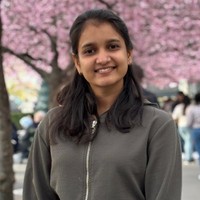
Rutu Gajera brings new perspectives on waste management systems from IIASA

Rutu Gajera, doctoral researcher at the Division of Energy Systems at KTH, spent three months at the International Institute for Applied Systems Analysis (IIASA) in Austria through the 2026 Young Scientists Summer Program (YSSP), gaining new perspectives and modelling skills for her research on circular waste and resource management systems.
Held from June to August 2026, the YSSP brought together doctoral researchers from around the world to work closely with IIASA researchers on interdisciplinary topics addressing global sustainability challenges.
During the YSSP, Rutu worked within IIASA’s research environment on developing a systems-based approach for sustainable resource and waste management, building on her doctoral research at KTH and contributing to ongoing work within the BioCircularR project .
Her work focused particularly on the application of the BeWhere optimization model to investigate spatially explicit pathways for resource recovery, technology deployment, and circular use of municipal solid waste and other available resources. This matters because decisions on where, when, and at what scale new waste treatment and resource recovery facilities are developed can shape environmental impacts, costs, transport needs, and resource recovery for decades. As cities generate increasing amounts of waste, planning these systems requires understanding how different parts of the system interact and how today's infrastructure decisions perform under different future conditions.
Rutu's research therefore explores how spatial and systems modelling can support more informed long-term decisions on the transition from waste disposal towards resource recovery and circular use of materials and energy. By analyzing different future scenarios, the work can help to identify where technologies may be most effective and how waste resources can be used more efficiently.

Working with researchers at IIASA also provided an opportunity to further develop skills in energy and resource systems modelling, scenario analysis, GIS-based data processing, and optimization, while exchanging ideas with researchers working across different disciplines and geographical contexts.
“The three months at IIASA were much more than just working on my model. Some of the most useful ideas came from conversations with my mentors and other YSSP participants, sometimes from completely different research fields. It made me question some of my own assumptions and look at my research from a broader perspective. I came to IIASA with a model and a research plan, but I am leaving with many new ideas, new connections, and a lot of motivation for the next phase of my PhD,” says Rutu.
At the end of the program, Rutu presented her research to the IIASA research community, sharing the methodological framework, scenario development, and preliminary results from the modelling work. Following the successful completion of the program, Rutu received the IIASA Young Scientists Summer Program 2026 certificate.

Rutu gratefully acknowledges the funding support provided by Formas , which enabled her participation in the IIASA Young Scientists Summer Program 2026. She also thanks her supervisor Dilip Khatiwada and co-supervisor Maryna Henrysson for their continued guidance and support.