
Circular Techno-Economic Analysis of Energy Storage– IEA Annex Co-coordination
The goal of this project is to facilitate stakeholders in characterizing the technical performance and in evaluating the economic feasibility of any energy storage technology based energy system, such as for heating/cooling, renewable energy and energy efficiency increase.
Introduction
The United Nations Sustainable Development Goals (SDGs) [UN, 2015][i] contain a matrix of visions towards a sustainable future. Associated with several SDGs, energy storage is one of the solutions to reach goal 7 Affordable and Clean Energy through energy shifting and peak shaving, goal 11 Sustainable Cities and Communities with better use of decentralized energy sources and goal 13 Climate Action with higher integration of intermittent renewable energy among others.
The project group involved in this proposal has since early 2000 quantified a number of technical and economic feasible solutions with storage systems. Examples are cost effective thermal power peak shaving of up to 9% of the demand in buildings with adequate storage design [Chiu, Martin and Setterwall 2009] [ii]; reduction of fossil fuel use in Swedish district heating system with implementation of energy storage by 13% [Chiu and Martin, 2011][iii]; harvesting and transportation of industrial surplus heat representing 20% to 50% of the total industrial energy use [Chiu et al. 2016][iv] [Fujii et al. 2018][v] [Gao et al. 2019][vi]. However, many commercial actors are still hesitant in implementing energy storage due to uncertainties in the initial investment costs and to uncertainties in long term rate of return.
In this project, we will further perform techno-economic analysis on various storage technologies with an additional focus on circular economy aspect. The package will be on development of methodological approaches to evaluate technical performance and economic indicators of energy storages, so as to assess and develop new business models in the energy systems. The analysis will cover all energy storage technologies (including electrical, thermal and chemical for heating/cooling and hydrogen as a storable energy vector), in both decentralized and centralized energy systems from all sectors.
Project Goals
The goal of this project is to facilitate stakeholders in characterizing the technical performance and in evaluating the economic feasibility of any energy storage technology based energy system, such as for heating/cooling, renewable energy and energy efficiency increase. In addition, sound implementation strategies for a circular techno-economy society will be benchmarked with the in-house developed holistic storage assessment methodology that will be made open source and available to the public. This work will serve as a contribution to the new IEA ECES Annex Economics of Energy Storage – EcoEneSto that will take place for a duration of three years 2021-2024.
Sub-goals:
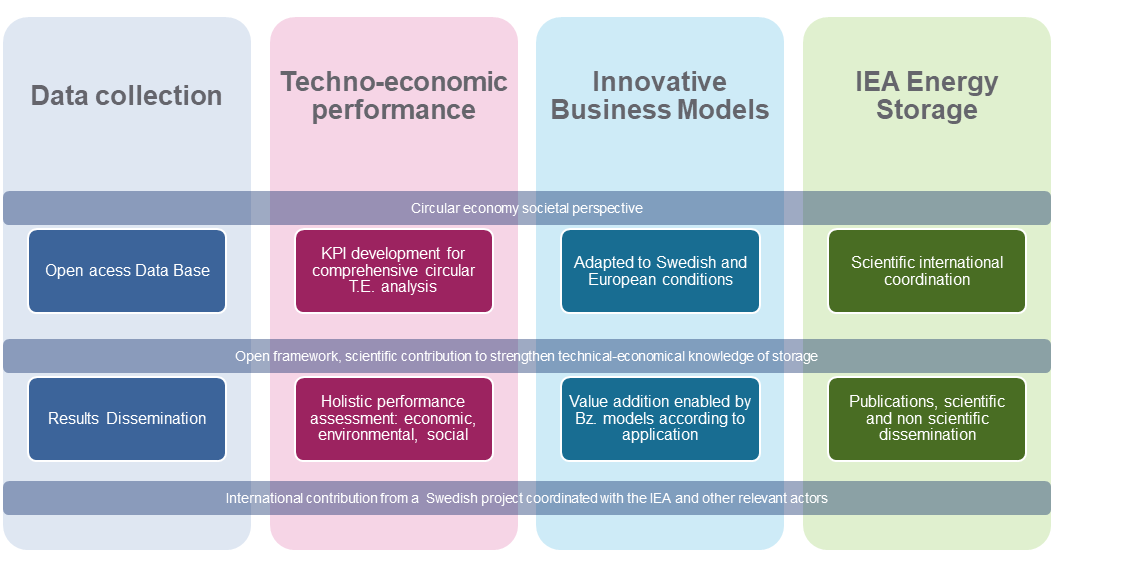
- Develop one measurable assessment framework as open source tools available online and corresponding techno-economic performance indicators for evaluating values and benefits of energy storages.
- Evaluate feasible business models by implementing circular economy strategies in energy storage systems
- Examine institutional processes that enable change and transformation towards circular practices for energy storage integrated systems with business case proposals.
- Enhance international collaboration and knowledge dissemination through co-coordination of IEA ECES for the new Annex “Economics of Energy Storage – EcoEneSto” (preliminary title) as subtask leader in “Techno Economic KPI Evaluation of Storage Integrated Energy Systems” (preliminary title).
Work Packages
Status: ongoing
Timeframe: 2021-2025
Researchers


Changes

For further information about this project, please contact Justin Chiu
References
[i] United Nations, Department of Economic and Social Affairs Sustainable Development. The 17 Goals. Available online: https://sdgs.un.org/goals
[ii] J. N. Chiu, V. Martin and F. Setterwall, "System Integration of Latent Heat Thermal Energy Storage Systems for Comfort Cooling Integrated in district cooling network," in 11th International Conference on Thermal Energy Storage, EFFSTOCK 2009, Stockholm, Sweden, June 14-17, 2009.
[iii] J. N. Chiu and V. Martin, "Thermal Energy Storage: Climate Change Mitigation Solution?," in International Conference for Sustainable Energy Storage, 2011.
[iv] J. N. W. Chiu et al., "Industrial surplus heat transportation for use in district heating," Energy, vol. 110, pp. 139-147, 2016.
[v] S. Fujii, Y. Kanematsu, Y. Kikuchi, T. Nakagaki, J. Chiu, V. Martin, “Techno economic analysis of thermochemical energy storage and transport system utilizing "zeolite Boiler": Case study in Sweden. Energy Procedia col.149 pp.102-111, 2018.
[vi] J. T. Gao et al., "Feasibility and economic analysis of solution transportation absorption system for long-distance thermal transportation under low ambient temperature," Energy Conversion and Management, vol. 196, pp. 793-806, 2019.