Digital Tokens and Forecasting Drive Proactive Energy Community Governance
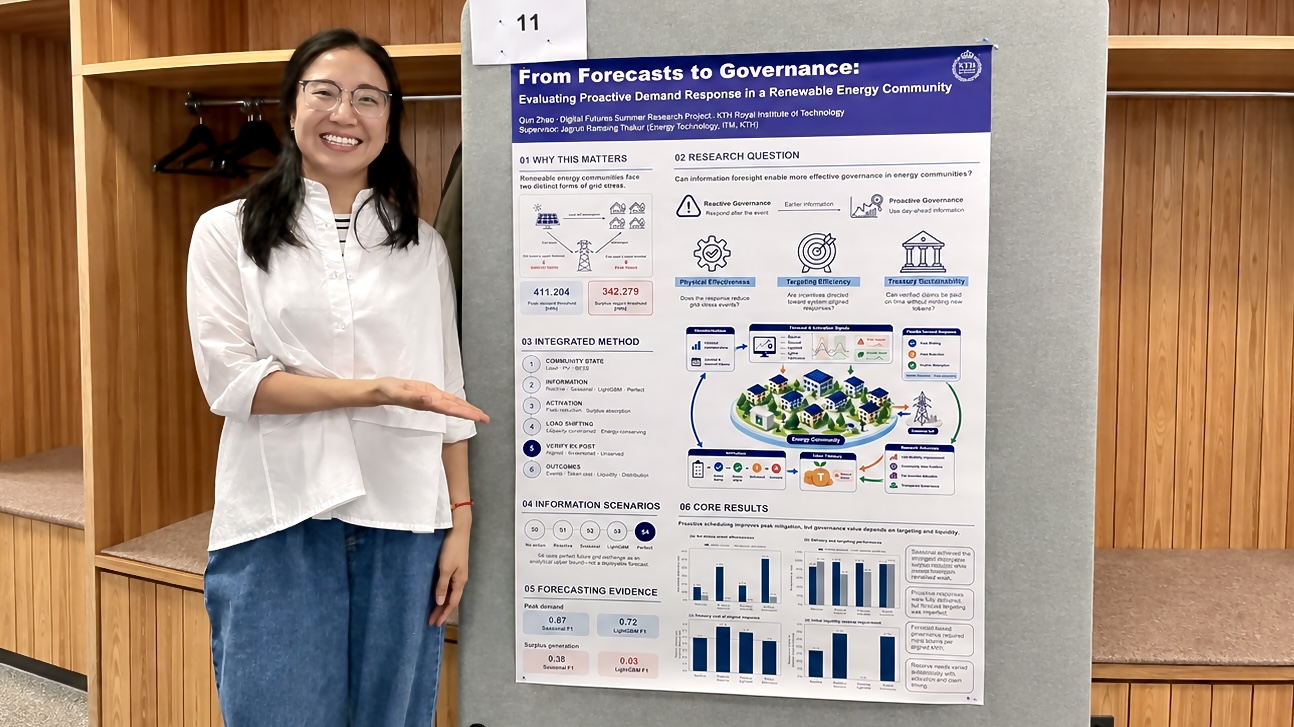
Digital Futures summer intern Qun Zhao spent the summer at KTH exploring how short-term energy forecasting can help renewable energy communities move from reactive responses towards more proactive and flexible energy governance.
The research was carried out under the supervision of Asst. Prof. Jagruti Ramsing Thakur at the HPT division, and formed part of the DECODE – Decentralized Energy Communities with a Digital Economy project.
The study compared reactive demand response with forecast-driven approaches for anticipating peak electricity imports and surplus renewable generation. Forecast signals were used to activate flexible demand in advance, while realised responses were verified afterwards. A token-based incentive mechanism - using digital reward units linked to actual energy contributions, was then used to assess the governance costs and liquidity needs of proactive action.
Results showed that foresight can substantially improve peak-demand mitigation when events are well predicted, while imperfect forecasts may also lead to misdirected responses, higher token costs and additional liquidity requirements.
The work was funded by Digital Futures and highlights how forecasting, flexible demand and digital incentives can be combined to support more proactive and sustainable energy community governance.
For more information about this work or to explore collaboration opportunities within related research areas at the HPT division, kindly contact Asst. Prof. Jagruti Ramsing Thakur.