Test facility for Rocket Nozzle Cooling Channels
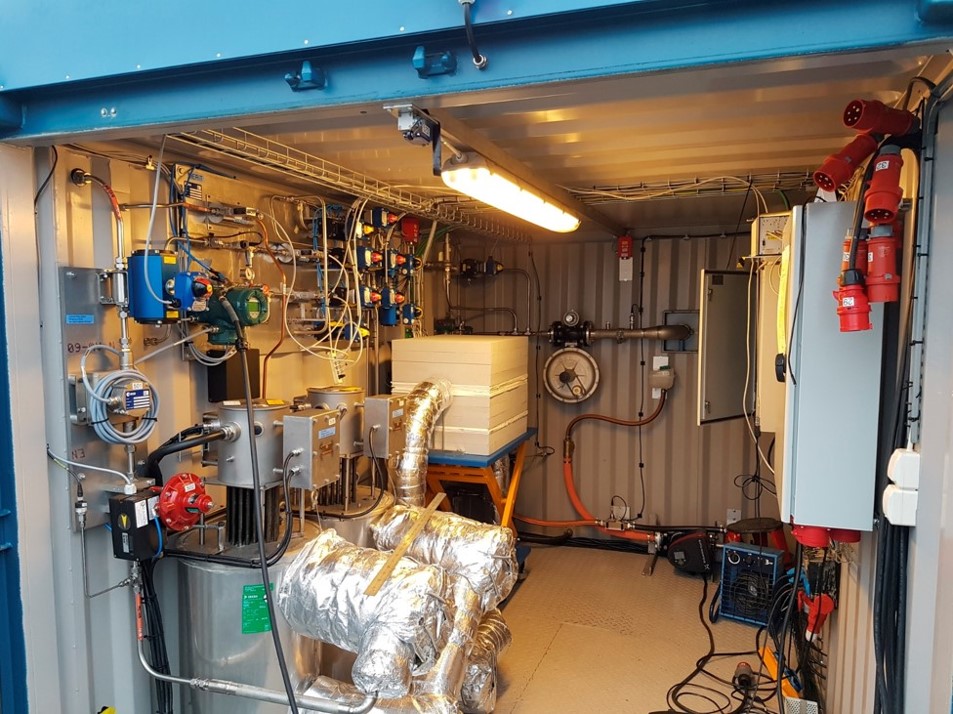
For future rocket propulsion systems it is of strategic importance to develop knowledge of the heat transfer characteristics and material influence at relevant operating conditions. The Rocket Nozzle Cooling Channels test facility is an experimental rig developed within the MERiT / MERiT+ programme to study hydrocarbon coolants (notably methane) under conditions representative of regeneratively cooled rocket nozzles, including elevated inlet temperature and high single-sided heat load.
The facility supports quantitative characterization of heat transfer coefficient, pressure losses, and the influence of channel geometry and nickel-alloy wall materials, including assessment of coking/corrosion and the onset of methane pyrolysis (thermo-catalytic decomposition) relevant to engine durability. Test facility was developed in collaboration with GKN Aerospace Sweden and ESA, with funding from the Swedish National Space Agency (SNSA).
Key technical parameters:
-
Fuel: Flexible (default CH4)
-
Max supply volume: 1200 l
-
Max. pressure: 20 MPa
-
Max. pre-heat: 250 °C
-
Max. heater power test section: 8.4 kW
Instrumentation:
-
Mass flow: Yokogawa Coriolis flow meter
-
Pressure: Yokogawa EJX series sensors
-
Temperature: Pentronic k-type thermocouples
-
Gas analysis: Optel Optim speed of sound transducers, Xensor thermal conductivity gauge
Safety features:
-
NI 9351 autonomous safety modules
-
Inert atmosphere in test cell (CO2)
-
O2 level monitoring
-
Combustible mixture monitoring
-
Cooling flow monitoring
-
Test section over heat protection
Access and contact
The Test Turbine is part of the Laboratory of the Division of Heat and Power Technology at KTH Energy Technology. External partners and students interested in using the facility for experiments, projects or theses are welcome to get in touch.