Transonic Linear Cascade
The Transonic Linear Cascade (TLC) is a linear cascade facility for experimental studies of transonic turbomachinery aerodynamics and aeroelasticity, developed to support aeroengine vibration research.
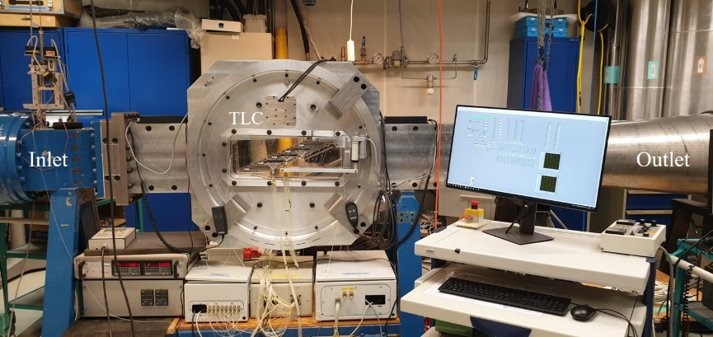
TLC test rig was primarily designed for aerodynamic damping and unsteady-response measurements with an oscillating central blade, enabled by CFD-designed contour walls that promote periodic blade-to-blade loading, and is used to investigate near-stall transonic compressor conditions with shock-induced separation as well as to generate reference datasets for numerical-method validation.
Key technical data:
-
Open-cycle wind tunnel
-
Number of blades: 5
-
Chord = 104.58 mm, Span = 70mm
-
Inlet Mach number: 0.8-1.2
-
Excitation frequencies: 1-2500Hz
-
Rotation angle variation: +- 7deg
-
Max mass flow: 4.7kg/s
-
Inlet temperature = 25-90 °C.
-
Tip gap: 1% chord
Intrumentation:
-
Non-intrusive: Laser vibrometer LKG-152, Laser-2-Focus anemometer, and Pressure Sensitive Paint.
-
Intrusive: Pressure acquisition via PSI Systems at 80 locations. Traverse five-hole probe measurements. Oil-flow visualizations.
-
Unsteady pressure measurements via miniature pressure transducer Kulite LQ-162.
More information and contact
TLC is part of the Laboratory of the Division of Heat and Power Technology at KTH Energy Technology, which also hosts multiple turbomachinery and high-speed test rigs and an air-supply system used across wind-tunnel testing activities. TLC was and is being used in various research projects at KTH, among recent ARIAS , .
External partners and students interested in using the facility for experiments, projects or theses are welcome to get in touch.