To KTH's start page

AI4PM - The effects of AI based predictive maintenance from life cycle perspective

This research project aims to develop, implement, and validate an integrated AI-based predictive maintenance and life cycle assessment framework for smart buildings. Using the KTH Live-In Lab, a highly instrumented student residential facility in Stockholm, as a testbed, the project will leverage real-time data from over 150 sensors collecting data every 10 minutes to model degradation in HVAC, piping, and other technical systems.
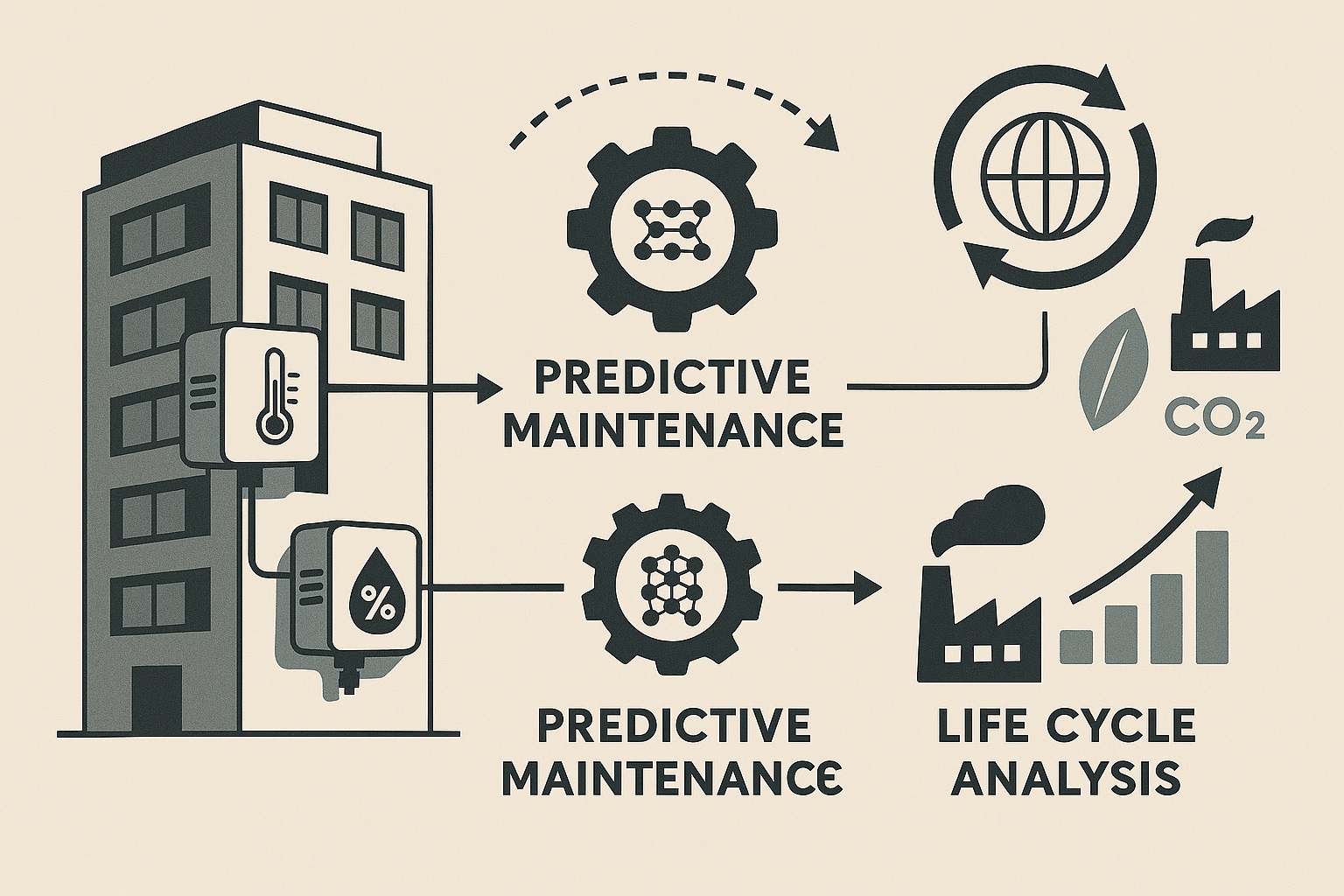
Image showing graphical abstract of the A14PM project

Background

Buildings account for a significant portion of global energy consumption and greenhouse gas emissions, making them a critical focus for sustainability efforts. Digital solutions, such as building monitoring systems, provide opportunities to optimize energy use and operational efficiency. However, their environmental implications, including production, operation, and disposal, remain largely underexplored. This interdisciplinary research aims to address this gap by developing, implementing, and validating a novel framework that combines predictive maintenance with LCA. This framework will quantify the net environmental impacts of Information and Communication Technology (ICT) systems in buildings, offering a comprehensive approach to assess both benefits and burdens. The project leverages the KTH Live-In Lab, a student housing testbed in Stockholm equipped with over 150 sensor data points recorded every 10 minutes, to harness real-time data and advanced machine learning algorithms. These tools will predict failures in building subsystems, such as heating, ventilation, and piping systems, with the goal of extending their functional lifespan, reducing maintenance costs, and optimizing energy and material use. Using LCA methodology, the study will critically evaluate the environmental costs of digital infrastructures, including sensors and communication hardware across their lifecycle. By introducing dynamic feedback between maintenance strategies and environmental performance, the project will provide insights into direct impacts and broader trade-offs, supporting sustainable building practices.

Aim and Objectives

The project aims to:  

  • Develop accurate machine learning models for predictive maintenance,  

  • Link these models to dynamic LCA to estimate the net environmental and economic impacts, including the extension of building component lifespans and cost savings,

  • Evaluate trade-offs in sensor deployment,

  • Identify an optimal balance between performance improvement and environmental footprint.

Project Partners

  1. KTH-ITM school

  2. KTH-ABE school

  3. KTH-liv-in-lab

  4. Einar Mattsson

Funding is provided by Digital Futures

Timeframe: 2026 - 2028

Keytags: Predictive maintenance, Buildings, LifeCycle Assessment, Digitalization, Data-driven applications, AI

Researchers

References

Digital Future's A14PM's Project Webpage

AI4PM - The effects of AI based predictive maintenance from life cycle perspective
ALT-BESS — Aging Models, LCA, and Advanced Tools for Stationary Energy Storage: Enhancing Battery Technologies and Supporting Global Decarbonization
A turnkey solution for Swedish buildings through integrated PV electricity and energy storage (PV-ESS)
BREAD – high-temperature Heat Pump with Integrated Storage - reversed BRayton cycle for combined hEAt and colD
Circular Techno-Economic Analysis of Energy Storage– IEA Annex Co-coordination
COMHPTES — Flexible Compact Modular Heat Pump and PCM based Thermal Energy Storage System for heat and cold industrial applications
DARLING — Damaged and Repaired Blade Modeling with in-situ Experiments
DETECTIVE – Development of a Novel Tube-Bundle-Cavity Linear Receiver for CSP Applications
Digital Twin for smart grid connected buildings
eLITHE – Electrification of ceramic industries high temperature heating equipment
FLEXnCONFU: Flexiblize Combined Cycle Power Plants through Power To-X Solutions using Non-Conventional Fuels
FLUWS — Flexible Upcycled Waste Material based Sensible Thermal Energy Storage for CSP
FRONTSH1P — A FRONTrunner approach to Systemic circular, Holistic & Inclusive solutions for a New Paradigm of territorial circular economy
HP4NAR — Next generation Heat Pumps with NAtural Refrigerants for district heating and cooling systems
HECTAPUS — Heating Cooling Transition and Acceleration with Phase Change Energy Utilization Storage
HYBRIDplus – Advanced HYBRID solar plant with PCM storage solutions in sCO2 cycles
I-UPS — Innovative High Temperature Heat Pump for Flexible Industrial Systems
Integrated Bioenergy Conversion and Thermal Storage for Negative-Carbon and Clean Technology Advancement
JOULIA — Electrification of industrial processes using induction and microwaves technologies
LCA-SESS — A new standard methodology for assessing the environmental impact of stationary energy storage systems
MERiT+ — Methane in Rocket nozzle cooling channels - conjugate heat Transfer measurements
Optimization of Molten Salt Electric Heaters
PED StepWise — Participatory Step-by-Step Implementation Process for Zero Carbon District Concepts in Existing Neighbourhoods
POWDER2POWER (P2P) — MW-scale fluidized particle-driven CSP prototype demonstration
PRINCESS - TriPly peRiodic mINimal SurfaCEs (TPMS) for Solar plantS
RECOPS — Resilience and cost benefits of open-source software in the power sector
Recycling of end-of-life wind blades through renewable energy driven molten salt pyrolysis process
ReMedBuild - Circular Connections: Bridging Healthcare and the Built Environment
RIHOND – Renewable Industrial Heat On Demand
SCO2OP-TES – sCO2 Operating Pumped Thermal Energy Storage for grid/industry cooperation
SHARP-SCO2 – Solar Hybrid Air-sCO2 Power Plants
STAMPE – Space Turbines Additive Manufacturing Performance Evaluation
SUSHEAT — Smart Integration of Waste and Renewable Energy for Sustainable Heat Upgrade in the Industry
USES4HEAT – Underground Large Scale Seasonal Energy Storage for Decarbonized and Reliable Heat
UP-FLEXH — Innovative High Temperature Heat Pump for Flexible Industrial Heat on Demand
V2Logistics – Vehicle-to-Grid for Freight Transport: Business Model pre-study
VILD — Virtual Integrated soLutions for future Demonstrators and products