
Multiphysics study of next-generation receiver designs for solar applications
Objective
The primary objective of the thesis is to design, simulate and test a TPMS-based solar point-focus receiver that optimizes the overall heat transfer and exergy performance.
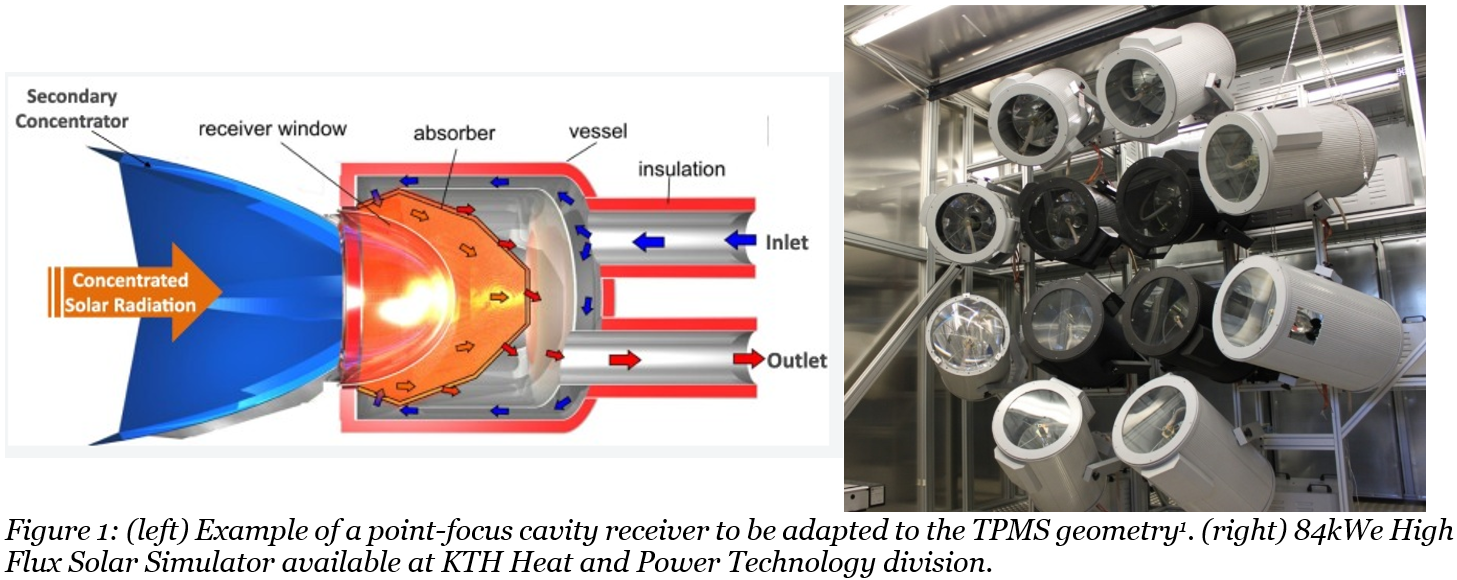
Figure 1: (left) Example of a point-focus cavity receiver to be adapted to the TPMS geometry[1]. (right) 84kWe High Flux Solar Simulator available at KTH Heat and Power Technology division.
Background
Concentrated solar power (CSP) is becoming an important source of clean energy in Europe’s push to decarbonize electricity and the industrial high temperature heat demand. Using air as a heat transfer medium instead of liquids in CSP systems allows working at high temperatures (increasing overall efficiencies), avoids toxic or corrosive fluids, saves water, and reduces the costs, but it limits heat transfer.
Adding triply periodic minimal surface (TPMS) can further improve solar receivers. TPMS are intricate, zero-curvature 3D structures that offer a high surface area for heat transfer. They enhance fluid mixing and heat exchange while keeping designs compact. Interest in TPMS has grown recently, and they provide an opportunity to develop high-performance, next-generation solar receivers.
Task description
Through a literature review of existing designs available for air-based point-focus solar receivers, initial and boundary conditions and test geometries are to be identified. Simulations of selected geometries are to be performed using ray tracing Monte Carlo models coupled to computational fluid dynamics (CFD) simulations to develop a robust complete multiphysics model.
- Ray tracing Monte Carlo models are to be developed for different geometries assessing the influence of the radiative heat distribution at the receiver.
- CAD models are to be developed to identify an optimum receiver and TPMS geometry.
- A comprehensive multiphysics model is to be developed to assess the overall component performance for different radiative heat flux distributions, initial conditions and TPMS and receiver geometries.
- Models will be validated with data from the literature and state-of-the-art concepts.
- The optimized geometries will be considered for 3D-printing and tested under the unique 84 kWe High-Flux Solar Simulator at KTH premises.
The main deliverables of the project include:
- Final project report and presentation.
- CAD / Multiphysics coupled models and simulation files with instructions.
Learning outcomes
This work is anticipated to offer:
- An in-depth knowledge of solar receiver design and simulation for CSP applications.
- Experience in developing complex multiphysics models.
- Potential scope of a publication in peer reviewed top tier journal - International Journal of Thermal Sciences, Applied Thermal Engineering, Applied Energy, Solar Energy Materials and Solar Cells, etc..
Prerequisites
- You should be admitted to first or second-level cycle education at a Swedish university.
- Additional preferred qualifications are as follows:
- Previous experience in developing computational fluid dynamics (CFD) models and computational aided design (CAD) components.
- Solid background and interest in developing new design solutions for next-generation solar energy technologies for the electricity grid and industrial decarbonization.
- Programming skills in Python and C++, with good understanding of Monte Carlo based models.
Duration
January 2027 – June 2027 (flexible)
How to apply
Contact the supervisors by email by 15 November 2026, including your CV and a cover letter describing your interest in the project and relevant qualifications.
Supervisors


Emily Fricke, efricke@kth.se
[1] Khan, M. I., Asfand, F., & Al-Ghamdi, S. G. (2023). Progress in research and technological advancements of commercial concentrated solar thermal power plants. Solar Energy, 249. https://doi.org/10.1016/j.solener.2022.10.041.